Trading Psychology Is Not an Information Problem
Most traders approach psychology incorrectly. They consume endless content about discipline, emotional control, patience, confidence, and mindset, but never actually train those qualities in a structured way. This is where trading psychology breaks down for the majority of market participants. Reading about emotional regulation is not the same thing as conditioning emotional regulation. Understanding a concept intellectually does not mean your nervous system has adapted to it under pressure.
This is why so many traders continue repeating the same destructive behaviors despite years of experience. Their knowledge improved, but their conditioning did not.
The good news is that nervous system regulation can absolutely be trained. The bad news is that it requires deliberate practice. Traders must stop viewing emotional control as a personality trait and start treating it as a performance skill developed through repetition and exposure. Just as athletes train movement patterns until they become automatic, traders must train emotional responses until calm execution becomes the default under stress.
The Hidden Nervous System Problem Behind Emotional Trading
Why Your Brain Treats Trading Like Survival
Most traders believe their biggest issue is strategy. In reality, many traders already know what they should be doing. They know where their entries should be. They know proper risk management. They know they should avoid revenge trading, FOMO chasing, and overtrading.
The issue is not informational. The issue is physiological.
When money, uncertainty, volatility, and self-worth become attached to market outcomes, the nervous system interprets trading stress as a threat. Once that happens, the brain shifts away from rational decision-making and toward emotional survival responses. This is why traders suddenly abandon plans they fully believed in five minutes earlier.
Under stress, the nervous system wants relief, not optimal execution.
That relief can come in many forms:
- Cutting winners too early
- Panic selling on pullbacks
- Avoiding valid entries
- Revenge trading after losses
- Oversizing positions
- Constantly checking P&L
- Micromanaging every candle
These behaviors are not random personality flaws. They are conditioned emotional responses.
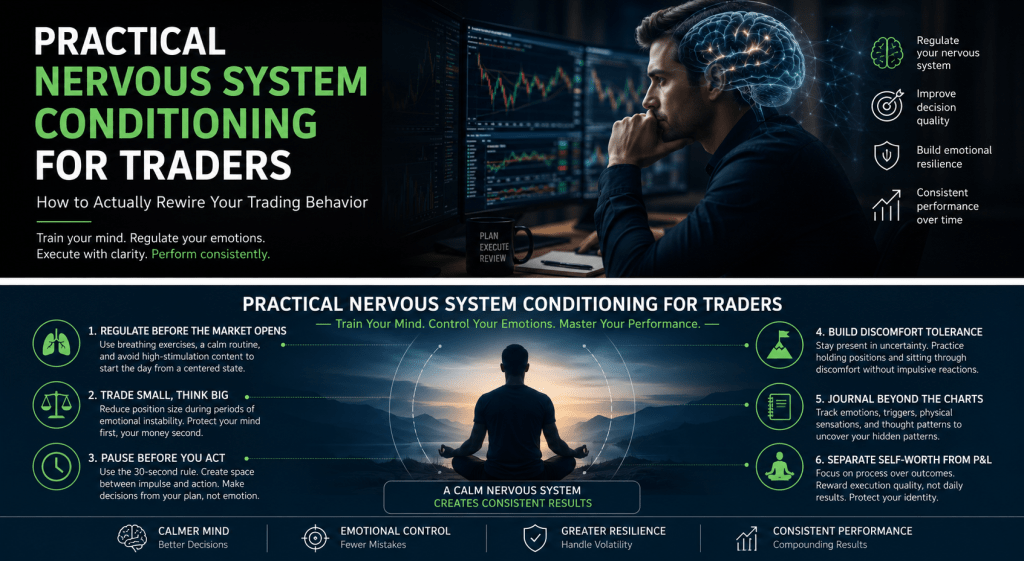
Building a Pre-Market Routine That Calms the Nervous System
How to Reduce Emotional Reactivity Before the Opening Bell
The first step is reducing baseline nervous system overload before the market even opens. Many traders begin the day already emotionally elevated. They wake up and immediately check futures, Twitter, Discord alerts, overnight news, watchlist scanners, and market opinions. By the opening bell their nervous system is already overstimulated.
This creates fragile emotional conditions where even normal volatility feels psychologically intense.
A far better approach is building a consistent pre-market routine designed to regulate emotional state before exposure to uncertainty begins. This does not need to become overly spiritual or complicated. The goal is simply entering the market from a calmer physiological baseline.
Pre-Market Habits That Improve Trading Performance
Avoid High-Stimulation Content Before the Open
Traders should avoid doomscrolling and emotionally charged content before the session begins. Social media outrage, hot takes, and aggressive market opinions increase nervous system activation before the first trade is even placed.
Review Setups Calmly Instead of Emotionally
Instead of emotionally anticipating action, traders should calmly review:
- Planned setups
- Key technical levels
- Risk parameters
- Potential scenarios
- Market conditions
- Sector strength and weakness
This shifts the brain from reactive mode into preparation mode.
Use Breathing Exercises to Lower Emotional Activation
Controlled breathing exercises can be extremely effective because breathing patterns directly influence nervous system activation. Slow nasal breathing or box breathing for even five minutes can significantly reduce emotional reactivity before the session begins.
Position Sizing and Emotional Stability
Why Smaller Position Sizes Can Dramatically Improve Trading Psychology
Another powerful conditioning method is intentionally reducing position size during periods of emotional instability. Most traders only think about sizing financially, but emotional sizing matters just as much.
If a position size creates obsessive chart watching, emotional swings, panic, or inability to follow the plan, then the size is too large for the trader’s current nervous system conditioning.
Trading smaller is not weakness. It is emotional training.
In fact, one of the fastest ways to improve trading psychology is to temporarily reduce size enough that the nervous system no longer enters survival mode during normal fluctuations.
The Psychological Benefits of Trading Smaller
Traders are often shocked by how much clearer they think once emotional overload decreases. They:
- Stop micromanaging candles
- Stop panicking over normal pullbacks
- Stop compulsively checking P&L
- Follow setups more consistently
- Hold winners more effectively
- Execute exits more rationally
This creates space for proper execution patterns to develop. Over time, as emotional stability improves, size can gradually increase while maintaining calm behavior. This is how professional conditioning is built.
Delayed Reaction Training for Traders
How to Stop Emotional and Impulsive Trading Decisions
One of the most effective exercises traders can practice is delayed reaction training.
Most emotional trading is impulsive. The nervous system wants immediate action to relieve discomfort. A trader sees red and instantly exits. A stock spikes and they chase emotionally. A loss occurs and they revenge trade to recover emotionally.
Delayed reaction training interrupts this loop.
The 30-Second Rule for Emotional Trading Decisions
Before any unscheduled action is taken, the trader forces a pause. Even thirty seconds matters. During this pause, the trader asks a simple question:
“Is this decision coming from my plan or from emotional discomfort?”
This sounds simple, but it is extremely powerful because it trains awareness between emotional impulse and behavior. Over time, traders begin recognizing emotional activation earlier instead of after damage has already occurred.
How Professional Traders Build Discomfort Tolerance
Why Most Traders Train Themselves to Avoid Discomfort
Another highly effective practice is training discomfort tolerance intentionally.
Most traders unknowingly spend years training avoidance behavior. They avoid emotional discomfort by:
- Cutting winners too early
- Avoiding entries after losses
- Taking profits prematurely
- Abandoning setups during volatility
The nervous system learns that discomfort should immediately be escaped.
Professional traders develop the opposite relationship. They learn to remain stable inside discomfort without impulsively reacting.
Practical Exercises to Improve Emotional Tolerance in Trading
This can be practiced directly.
For example, if a trader consistently exits winners too early, they can intentionally create structured holding exercises. Instead of selling the full position immediately, they hold a smaller partial position according to predefined rules regardless of emotional discomfort.
The goal is not maximizing profit initially. The goal is teaching the nervous system that uncertainty and pullbacks can be tolerated safely without immediate escape behavior.
Overcoming Hesitation and Fear of Entry
Why Traders Freeze on Good Setups
The same principle applies to hesitation. Many traders hesitate because the nervous system associates entry execution with danger due to prior emotional pain.
The solution is not motivational self-talk.
The solution is gradual exposure training.
How to Rebuild Confidence Through Repetition
Traders should focus on taking properly sized, high-quality setups repeatedly while emphasizing execution quality rather than P&L outcome.
Over time, the nervous system begins associating disciplined execution with safety rather than threat.
This is how genuine trading confidence is built. Not through hype. Not through affirmations. Through repeated evidence that disciplined behavior is survivable and sustainable.
Trading Journals Should Track Emotions, Not Just Setups
Why Most Trading Journals Miss the Real Problem
Journaling should also evolve beyond technical analysis. Most trading journals focus entirely on:
- Setups
- Entries
- Exits
- Profit metrics
- Win rates
While ignoring emotional data entirely.
This misses the deeper source of inconsistency.
What Traders Should Actually Track Emotionally
Traders should begin documenting:
- Thoughts before impulsive decisions
- Physical sensations during stress
- Emotional triggers
- Frustration patterns
- Confidence fluctuations
- Outside stressors affecting performance
The goal is pattern recognition.
Many traders eventually discover that their worst behaviors are highly predictable. Some overtrade when bored. Others revenge trade when embarrassed. Others become impulsive after large wins because dopamine levels spike.
Once these patterns become visible, intervention becomes possible before destructive behavior escalates.
The Link Between Dopamine, Social Media, and Poor Trading
How Overstimulation Destroys Trading Patience
Reducing overall stimulation outside trading is another deeply overlooked aspect of conditioning.
Modern attention spans are being destroyed by constant digital stimulation. Short-form content, endless notifications, rapid scrolling, and instant dopamine loops train the brain toward impulsiveness and reduced patience.
Then traders wonder why they cannot sit calmly through consolidations or wait for proper setups.
Patience is not just a trading skill. It is a nervous system state.
Lifestyle Habits That Improve Trading Discipline
Traders who constantly overstimulate themselves outside market hours often bring that same restless energy into execution.
Improving trading psychology sometimes requires improving lifestyle regulation overall. Better:
- Sleep
- Exercise
- Nutrition
- Recovery
- Quiet time
- Reduced information overload
All improve nervous system resilience dramatically.
Separating Self-Worth From Trading Results
The Dangerous Emotional Cycle Most Traders Live In
Perhaps the most important conditioning principle of all is separating self-worth from short-term outcomes.
Many traders unknowingly attach identity to daily P&L fluctuations. Green days create confidence and emotional highs. Red days create shame, frustration, and self-doubt.
This creates enormous emotional instability because self-worth becomes dependent on variables outside direct control.
Why Professional Traders Focus on Process Over Outcomes
Professional traders learn to emotionally reward process quality rather than short-term outcomes.
A well-executed loss becomes psychologically acceptable because the trader values proper execution more than immediate reinforcement.
This is one of the biggest transitions in trading development.
The amateur nervous system seeks emotional reward from winning.
The professional nervous system seeks emotional reward from process consistency.
Over time this completely changes the emotional experience of trading. The market stops feeling like a constant threat to identity. Losses become manageable. Volatility becomes less emotionally consuming. Decision quality improves because emotional survival is no longer tied to every trade.
Final Thoughts on Nervous System Conditioning for Traders
Emotional Stability Is the Real Trading Edge
Ultimately, nervous system conditioning in trading is not about becoming emotionless. That is impossible.
The goal is becoming emotionally stable enough that feelings no longer dictate execution quality.
Great traders still feel fear, uncertainty, frustration, excitement, and stress. The difference is that those emotions no longer fully control behavior.
That level of regulation is not built through motivation. It is built through conditioning, repetition, awareness, and deliberate practice over time.
Want more insights on trading?
For more on swing trading check out my swing service at bullsonwallstreet.com
Follow me on twitter and instagram.
Information on Personal Mentoring.
Author Bio
Paul J Singh is a 20+ year trader, Bullonwallstreet.com Swing Trading Coach, and swing trading mentor. He teaches traders how to combine technical analysis, options, risk management, and performance psychology into a repeatable edge.


Leave a comment