
Your Winning Trades Will Crush You (And You Won’t Even See It Coming)
What if I told you that your biggest problem in trading isn’t your losses, your bad entries, or even your discipline on red days, but your wins?
That’s right, your wins.
Most traders spend years obsessing over losses, replaying them in their heads, journaling every mistake, and convincing themselves that if they could just clean up those red trades everything would fall into place. Meanwhile, the real leak sits quietly in their account, disguised as progress, disguised as competence, disguised as success. Your wins are what keep you stuck because they feel good, they validate your decisions, and they give you just enough confidence to keep repeating the exact behavior that is holding you back from real profitability.
The Illusion of Winning
When you pull up your stats and see a 65% win rate, it creates an illusion that you are doing something right. It feels like you are close, like you are just a few tweaks away from breaking through, so naturally you go back and review your last hundred trades. Like almost every trader, you focus on the losers, circling bad entries, highlighting mistakes, and convincing yourself that if you could just eliminate those you would suddenly transform into the next Jesse Livermore. But that is not how this works, and it never has been, because most of your losses are not the real problem. Your wins are.
The Hidden Math
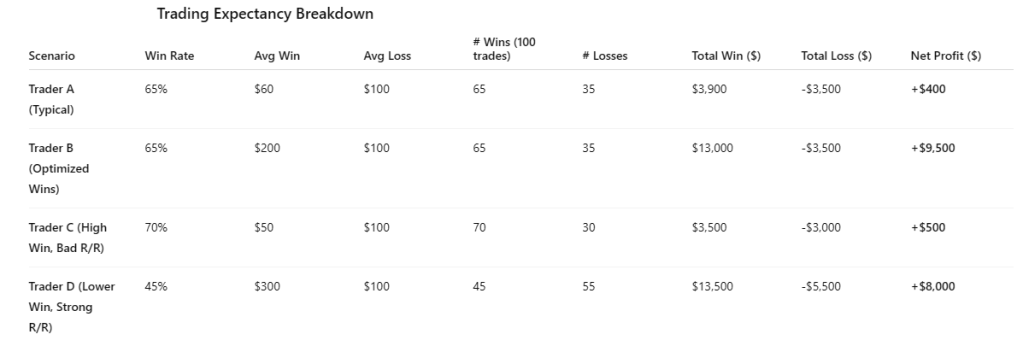
The issue is that your win rate is lying to you. It is giving you a false sense of competence while quietly sabotaging your long-term results. If you risk $100 per trade and lose 35 times, you are down $3,500, which is expected. But if your 65 winning trades only average $60 each because you are constantly taking profits too early, you end up with $3,900 in gains, leaving you with a net profit of just $400 after one hundred trades. That is barely anything, and it does not account for commissions, slippage, or inevitable mistakes. Now imagine nothing else changes except your ability to hold winners, and instead of $60 your average win becomes $200. Suddenly those same 65 wins produce $13,000 against $3,500 in losses, and now you are up $9,500. Same trader, same setups, same win rate, but a completely different outcome simply because you learned how to win.
Cutting Winners Early
This is where most traders quietly destroy themselves without realizing it, because the trades are still green. The first and most common issue is cutting winners early, which is driven by fear more than anything else. You enter a trade with a plan, price moves in your favor, and the moment you have a small gain your mind starts racing with thoughts about giving it back, about protecting what you have, about locking something in. So you exit, telling yourself you are being disciplined, but what you are really doing is capping your upside while leaving your downside untouched. Over time, this creates a system where your losses remain full-sized while your gains are consistently reduced, and that math will never work no matter how often you are right.
Structureal Leak
The second issue is more structural and often goes unnoticed even by experienced traders, which is that your wins are smaller than your losses by design. You might be holding your trades longer than the average beginner, but if you are risking $100 to make $80 or even $50, you are still setting yourself up for failure. This is how traders with high win rates still end up losing money, not because they lack skill, but because their framework guarantees that even when they are right most of the time, they cannot generate meaningful profitability.
The uncomfortable truth is that most traders do not actually know how to win. They know how to enter trades, they know how to manage risk on the downside, and they know how to feel good about being right, but they do not know how to extract real money from the market when they are correct. Winning in trading is not about collecting small green trades, it is about positioning yourself so that when you are right, the outcome matters in a significant way. It requires patience, it requires trust in your process, and it requires a willingness to sit through discomfort as a trade develops rather than rushing to close it the moment it shows profit.
Audit Your Winners
If you want to fix this, you have to shift your focus entirely. Instead of reviewing your losses, go back and analyze your winning trades in detail. Look at your last fifty or one hundred wins and ask yourself whether you actually followed your plan or if you deviated once the trade started working. Ask whether your reward was meaningfully larger than your risk or if you simply took whatever the market gave you. Ask whether your exits were based on changes in the setup or based on your emotions in the moment. These questions will expose patterns that you have likely ignored for years, and they will show you exactly where your edge is being eroded.
Mindset
Winning traders think very differently about their performance. They are not obsessed with being right, and they do not measure success by win rate. They focus on getting paid when they are right, understanding that a lower win rate combined with strong reward-to-risk will outperform a high win rate with capped upside every single time. They accept that some trades will come back and that not every winner will be maximized, but they consistently create conditions where their upside is meaningful enough to outweigh those imperfections.
If you truly want to trade like the greats, you have to let go of the need to feel good about your win rate and start focusing on expectancy instead. You have to ask yourself whether your trading allows for outsized gains when you are right, whether your structure supports profitability over a large sample size, and whether you are giving your trades enough room to develop into something meaningful. Because in the end, trading is not about winning often, it is about winning well.
Most traders never figure this out. They spend years refining entries, chasing indicators, and trying to eliminate losses, all while ignoring the fact that the very trades they celebrate are the ones holding them back. Your wins are not proof that you are doing things right, they are the first place you should look when something is not working, and once you learn how to fix them, everything changes.
Want more insights on trading?
For more on swing trading check out my swing service at bullsonwallstreet.com
Follow me on twitter and instagram.
Information on Personal Mentoring.
 Paul J Singh
Leave a comment