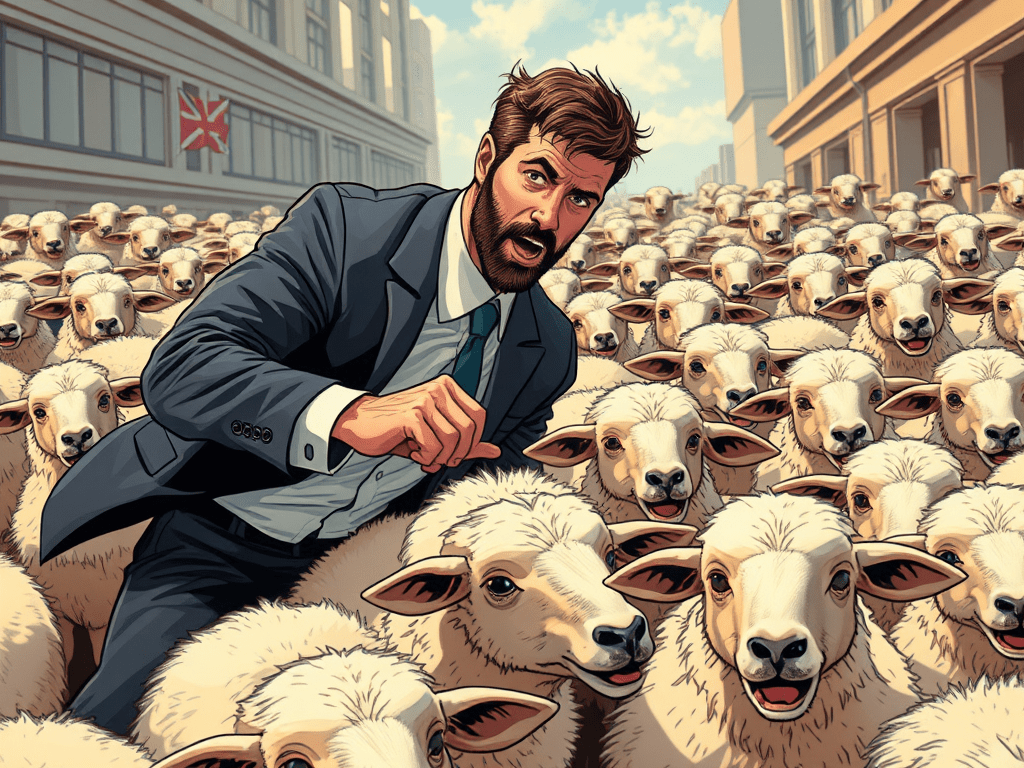
Financial markets are often described as a battle between bulls and bears, but that description misses something deeper. Markets are not just contests between buyers and sellers. They are expressions of collective human behavior. Every price reflects the decisions of millions of investors, traders, institutions, and algorithms acting on different information and emotions.
This raises one of the most important questions in trading. Should you trust the crowd or fight it?
The answer is not simple. Sometimes the crowd is extraordinarily intelligent. At other times it becomes irrational and self reinforcing. Understanding the difference is one of the most valuable skills a trader can develop.
Why Markets Often Get It Right
Markets are powerful information processing systems. Every day investors analyze earnings reports, economic data, interest rates, geopolitical developments, and technological change. Each participant interprets that information through their own lens and expresses it through buying or selling.
Over time this process aggregates enormous amounts of knowledge into price.
Economist Friedrich Hayek described this phenomenon decades ago when he wrote about the power of decentralized information. No single individual possesses all the knowledge required to make complex economic decisions, but markets allow dispersed information to be combined through price signals.
This is one reason markets are so difficult to consistently outperform. Price already reflects the collective judgment of millions of participants.
Professional traders eventually learn a painful lesson. Fighting price is usually a mistake. If capital is flowing into a sector or asset class, that flow often reflects information that has not yet become obvious to everyone.
Trend following strategies are built on this idea. Instead of assuming the crowd is wrong, trend traders assume the crowd often sees something real. If money is flowing into semiconductors, energy, or industrials, the trend itself becomes evidence of collective insight.
The Power of Independent Thinking
Markets work best when participants think independently.
Different investors operate on different time frames and with different strategies. Some analyze macroeconomic cycles. Others focus on earnings growth, valuations, or technical patterns. Still others react to supply chains, innovation, or political risk.
Because these viewpoints are diverse, the market benefits from a wide range of information.
Disagreement is not a flaw in markets. It is the reason markets function.
Investor Howard Marks frequently emphasizes this point when discussing investment cycles. If everyone agreed about the future, there would be no trades. Prices move precisely because intelligent people interpret information differently.
This diversity of opinion allows markets to incorporate vast amounts of information quickly and efficiently.
When the Crowd Stops Thinking
The danger appears when independence disappears.
Instead of evaluating information themselves, investors begin copying each other. Decisions become driven by narrative rather than analysis. Momentum attracts attention, which attracts more momentum.
This is how bubbles form.
Scottish journalist Charles Mackay famously documented this phenomenon in the nineteenth century when he wrote about financial manias and speculative frenzies. His observation still applies today. People can become irrational when they act as part of a crowd.
When imitation replaces independent thinking, markets become fragile.
Prices rise because people see prices rising. Investors buy because others are buying. Analysts justify valuations because the trend has already moved higher.
Eventually the crowd begins reinforcing itself.
The Danger of Consensus
One of the most reliable warning signs in markets is overwhelming consensus.
Legendary investor John Templeton summarized this dynamic clearly when he said that the time of maximum pessimism is the best time to buy, while the time of maximum optimism is the best time to sell.
Extreme consensus often signals that the market has already acted on a narrative.
When everyone believes the same story, most of the capital that can support that view has already been deployed. Once positioning becomes one sided, the risk of reversal increases dramatically.
This pattern appears repeatedly in financial history.
Technology stocks in the late 1990s, housing in the mid 2000s, and various speculative assets in more recent years all experienced periods where investors shared nearly identical beliefs about the future.
The problem with consensus is not that it is always wrong. Sometimes the crowd is correct about long term trends. The problem is that when everyone agrees, the market often becomes vulnerable to surprise.
Why Volatility Reveals Crowd Psychology
Periods of market volatility expose crowd behavior more clearly than quiet markets.
During geopolitical conflicts, economic uncertainty, or rapid corrections, fear spreads quickly. Investors hedge risk aggressively. Institutions reduce exposure. Media narratives amplify anxiety.
The crowd reacts emotionally.
Behavioral economist Daniel Kahneman demonstrated how humans systematically misjudge risk under uncertainty. Losses feel more painful than gains feel rewarding, which leads investors to react strongly during market declines.
As fear spreads, positioning becomes extreme. Traders buy protection. Volatility spikes. Capital moves rapidly toward perceived safety.
Ironically these moments often create opportunity.
When pessimism becomes overwhelming, the market may already have priced in the worst case scenario. Even small positive developments can trigger powerful rallies as investors unwind defensive positioning.
The Balance Between Following and Fading the Crowd
The greatest traders understand that both following and opposing the crowd can be profitable depending on context.
When markets are functioning normally and capital flows reflect diverse analysis, following trends can be extremely effective. Momentum often reflects real economic or technological shifts that unfold over long periods.
But when the market becomes emotionally crowded, contrarian opportunities begin to emerge.
Investor George Soros described markets as reflexive systems in which perceptions influence reality. When investors become overly confident about a narrative, their collective behavior can push prices far beyond sustainable levels.
Eventually that feedback loop breaks.
The key skill is recognizing when markets are reflecting information and when they are reflecting emotion.
Modern Markets and Accelerated Crowd Behavior
Today’s markets amplify crowd dynamics more than ever before.
Information spreads instantly through social media, financial news, and algorithmic trading systems. Narratives can spread across the world in minutes rather than months.
This acceleration has two effects.
First, markets can process information extremely quickly. Earnings surprises, economic data, and policy changes are incorporated into price almost instantly.
Second, herd behavior can develop faster than ever before. Narratives gain traction quickly, and traders can pile into crowded trades within days rather than years.
For traders this environment requires constant awareness of sentiment and positioning.
Understanding what the crowd believes becomes as important as understanding fundamentals.
The Real Edge for Traders
Most trading education focuses on charts, indicators, and economic data. Those tools matter, but they only explain part of market behavior.
Markets are ultimately systems driven by human decisions.
Behind every chart pattern or price movement are investors reacting to information, incentives, and emotions. Fear, greed, confidence, and uncertainty all shape how the crowd behaves.
The real edge comes from understanding when the market is processing information intelligently and when it is simply reacting to its own momentum.
Great traders respect the intelligence of the market. They know that price often reflects insights that are not yet obvious.
But they also recognize the moments when the crowd becomes trapped in its own narrative.
Those moments, when independence disappears and consensus becomes extreme, are when the most powerful opportunities often emerge.
In our next article, we will go from theory to practice. We will explore the technicals of price action and learn how to actually trade crown behavior.
Want more insights on trading?
For more on swing trading check out my swing service at bullsonwallstreet.com
Follow me on twitter and instagram.
Information on Personal Mentoring.
 Paul J Singh
Leave a comment