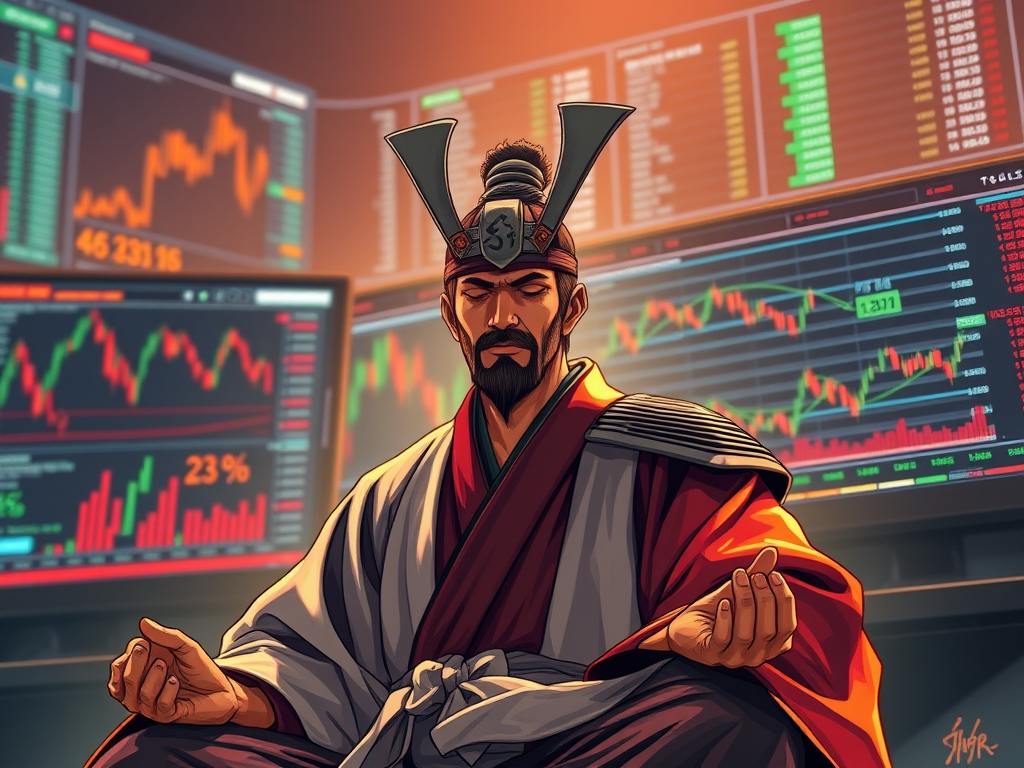
When the Market Turns Volatile, You Must Not
When the market turns volatile, you must not. You gain an edge by staying calm while everyone else loses their cool. Stay patient and look for edges and exploitable mistakes.
Volatility doesn’t change the market. It reveals behavior.
Every spike in fear exposes the same flaws: rushed decisions, abandoned plans, emotional risk-taking, and a growing disconnect between price and reality. That disconnect is where opportunity lives—but only if you’re mentally prepared to operate when others aren’t.
Below are the five psychological principles that matter most when markets turn chaotic.
1. Calm Is a Competitive Advantage
In volatile markets, emotional stability becomes a form of edge.
Most participants are not competing on analysis. Instead, they’re competing on reaction speed to fear. The faster the market moves, the more mistakes get made. Stops are widened out of panic. Entries are chased. Risk is added at the worst possible time.
If you can stay calm, you automatically move into the top tier of participants. You don’t need better information. You need better emotional control.
That alone puts you ahead of the crowd.
2. Better Decisions Come From Slower Thinking
Volatility compresses time. Everything feels urgent. Every candle looks like the one that “matters.”
That urgency destroys decision-making.
When traders rush, they skip checklists, violate position sizing rules, and justify poor trades emotionally. Calm traders slow the game down. They let price form. They don’t micro-manage and react to every tick.
Good decisions compound. Bad decisions cluster. Volatile markets magnify both.
3. Volatility Creates Mispricing
Fear is inefficient.
When emotion drives markets, price moves faster than logic. Strong stocks get sold alongside weak ones. Long-term trends temporarily disconnect from short-term liquidity events. Options premiums inflate. Risk becomes overpriced.
These distortions don’t last. You only need a window.
The trader who understands mispricing isn’t trying to predict the future. They’re exploiting the present. The gap between fear-driven price and probabilistic reality creates an exploitable edge.
4. Fear Produces Irrational Behavior
Fear changes how people process information.
Traders overweight negative headlines. They assume worst-case scenarios. They extrapolate recent losses indefinitely into the future. They stop thinking in probabilities and start thinking in absolutes.
This is why markets overshoot on the downside.
Irrational behavior isn’t random: it’s patterned. Panic selling, forced liquidation, emotional hedging, and “get me out at any price” decisions all follow the same script. Recognizing that script allows you to act rationally while others can’t.
5. Follow Signals, Not Predictions
Volatile markets punish prediction and reward signal-following.
Calling bottoms, guessing headlines, or trying to forecast macro outcomes leads to oversized risk and poor timing. Signals like trend structure, volatility contraction, relative strength, reclaiming key support and resistance levels keep you grounded to your trading edges.
You don’t need to know why the market will turn. You need to recognize when conditions begin to change.
Signals keep you flexible. Predictions lock you in.
After Fear, the Market Has Always Come Back
This is the part traders forget in real time.
Fear feels permanent when you’re inside it. Every headline reinforces the same story: “This time is different.” It never is.
Look back at history:
After the pandemic, markets experienced one of the sharpest selloffs ever recorded. However, the news event was quickly followed by a historic recovery that punished anyone who stayed frozen in fear.
During tariff wars and trade tensions, volatility surged repeatedly. Each episode felt existential. Each one created sharp dislocations. And each one eventually resolved into higher prices as uncertainty faded and sellers were exhausted.
Rate scares, inflation fears, banking stress, geopolitical shocks—the pattern repeats. Fear spikes first. Liquidity dries up. Prices overshoot. Then sellers run out.
Markets don’t recover because the news suddenly improves. They recover because fear eventually gets priced in faster than reality unfolds.
By the time clarity arrives, opportunity is often gone.
This is why the biggest gains tend to follow the most uncomfortable periods. The recovery doesn’t wait for confidence. It starts while most traders are still processing losses.
Final Thought
Volatility is not the enemy. Emotional reaction is.
When the market turns volatile, you must not.
Stay calm while others lose their cool. Stay patient while others rush. Focus on signals, not predictions. Look for mispricing created by fear and irrational behavior.
Because history has been consistent on one thing:
After periods of fear and volatility, the market doesn’t just stabilize.
It comes roaring back.
Want more insights on trading?
For more on swing trading check out my swing service at bullsonwallstreet.com
Follow me on twitter and instagram.
Information on Personal Mentoring.
Author Bio
Paul J Singh is a 20+ year trader, Bullonwallstreet.com Swing Trading Coach, and swing trading mentor. He teaches traders how to combine technical analysis, options, risk management, and performance psychology into a repeatable edge.
 Paul J Singh
Leave a comment